
Nanjing, April 2026 — The Second Nanjing Audit University–University of Birmingham Student Academic Forum, co-hosted by the Institute of Economics and Finance (IEF) of Nanjing Audit University and Birmingham Business School of the University of Birmingham, was successfully held from 7 to 8 April at the Mochou Campus of Nanjing Audit University.
Under the theme "Gathering Youth Wisdom, Discussing Global Issues", the forum brought together nearly 30 outstanding student representatives from the University of Birmingham, Nanjing Audit University, and a number of other Chinese and British universities, including Nanjing University, Nanjing University of Aeronautics and Astronautics, Nanjing Agricultural University, Xi'an Jiaotong University, Hefei University of Technology, Zhongnan University of Economics and Law, and Jinan University. Participants engaged in in-depth academic exchange and intellectual discussion across four frontier topics — "Markets, Policy and Prices", "Climate Change and Finance", "Artificial Intelligence and Applied Economics", and "Institutional Change" — injecting new vitality into the two universities' collaboration in talent development and academic exchange.
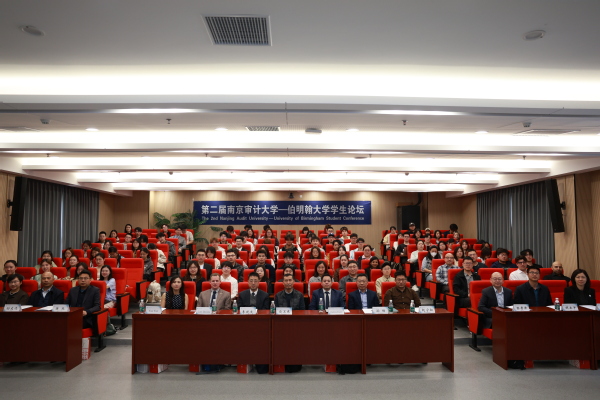
Opening Ceremony: Building a New Platform for Youth Academic Exchange
The opening ceremony was held in grand style. Attendees included Mr. Yu Weidong, Second-Level Researcher of the Jiangsu Provincial Department of Education; members of the University of Birmingham delegation; and leaders of Nanjing Audit University. The Nanjing Audit University attendees included Professor Li Qianwen, Vice President; Mr. Qiang Biao, Director of the Mochou Campus Office; Mr. Sun Wenyuan, Director of the Student Affairs Office; Ms. Liu Yan, Director of the Academic Affairs Office; Mr. Zhang Jinjin, Party Secretary of the International School (International Joint Audit Institute); Mr. Hu Yeyu, Secretary of the Communist Youth League Committee of Nanjing Audit University; Ms. Yang Yan, Deputy Director of the Office of International Cooperation and Exchange; and Professor Sun Yang, Dean of the Institute of Economics and Finance. The University of Birmingham delegation comprised Professor Ceri Davies, Head of Teaching in the Department of Economics at Birmingham Business School; Dr. Allan Beltran Hernandez, Director of Undergraduate Programmes in the Department of Economics; and Professor Yao Yao, Director of Taught Postgraduate Programmes. Faculty and student representatives from the Institute of Economics and Finance, as well as representatives from universities across the country, were also invited to attend. The opening ceremony was chaired by Mr. Wang Peng, Vice Dean of the Institute of Economics and Finance.
In his address, Professor Li Qianwen, Vice President of Nanjing Audit University, noted that academic exchange is an important driver of knowledge advancement and a key bond for deepening international cooperation. He emphasised that academic exchange has always been a vital force for advancing knowledge and a crucial link for continuously deepening international cooperation. This forum not only sustained the strong momentum of cooperation between the two sides but also built an open and diverse academic exchange platform for young scholars from China and the UK. He expressed his expectation that new insights would emerge from the collision of ideas, offering further inspiration for academic research and real-world development.
Mr. Yu Weidong, Second-Level Researcher of the Jiangsu Provincial Department of Education, congratulated the convening of the forum. He fully affirmed the achievements of cooperation and exchange between Nanjing Audit University and the University of Birmingham, and put forward three hopes for the students participating in the forum: to broaden their international horizons and come to understand the world through deeper exchange; to think diligently and spark innovative ideas through intellectual collision; and to stay grounded and serve the economic and social development of Jiangsu through practice.
Deepening Cooperation: From One-Way Sending to Two-Way Co-Education
Professor Sun Yang, Dean of the Institute of Economics and Finance of Nanjing Audit University, presented the Institute's achievements in internationalisation. He noted that cooperation between NAU and the University of Birmingham has upgraded from the initial stage of "one-way sending" to a new stage of "two-way co-education". The Economics (China-UK Mutual Credit Recognition Joint Programme) run by the two universities has sent eight cohorts totalling 141 students, and 100% of its graduates have received postgraduate offers from world-leading institutions such as Oxford, Cambridge, and the London School of Economics and Political Science — a remarkable record in talent development. Inviting a student delegation from the University of Birmingham to China marks a deeper level of interaction and integration in the two universities' cooperation and is an important embodiment of the "two-way co-education" philosophy.
Professor Ceri Davies of Birmingham Business School introduced the distinguishing features and strengths of the business school and its Department of Economics, and expressed high expectations for deeper future collaboration between the two universities in talent development and research cooperation.
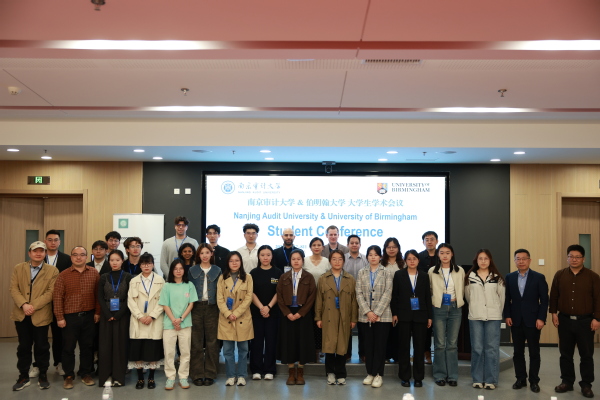
An Academic Feast: Four Themes Leading Frontier Discussion
The forum spanned two days and featured four thematic sub-forums covering "Markets, Policy and Prices", "Climate Change and Finance", "Artificial Intelligence and Applied Economics", and "Institutional Change". Students and scholars from Xi'an Jiaotong University, Nanjing University, Nanjing University of Aeronautics and Astronautics, Hefei University of Technology, Zhongnan University of Economics and Law, and Jinan University, as well as from the University of Birmingham, shared their latest research findings on topics including the digital economy and technological application, the green economy and sustainable development, macroeconomics and policy impacts, financial markets and corporate behaviour, and social and livelihood issues.
Weak Adjustment and Strong Shock: How the Phase-Out of New Energy Vehicle Subsidies Affects Labour Demand
Regional Financial Competition and Cross-Regional Capital Flows of Enterprises: A Discussion on the Construction of a Unified National Market and Regional Coordinated Development
Do Animal Spirits Have Greater Impact on LBO Activity and Pricing Than Credit Spreads?
The Domestic Price Effects of the U.S.–China Trade War in China
Research on the Impact of Digital Transformation on Corporate Tax Burden: Based on the Dual Perspectives of "Governance Effect" and "Financial Effect"
Immigration and Local Prices: Micro Evidence from Demand-Side Composition Effects
The Residential Real Estate Market in China: Assessment and Policy Implications — Focusing on the 2019 LPR Reform and Its Effects on Housing Prices and Sales
The Impact of Carbon ETS on GTFP: Focusing on the Moderating Role of FDI
Pricing in the Unknown: The Link between Climate Policy Uncertainty and Chinese Bank Lending
Digital Platforms Empowering Green Trade: Cross-border E-commerce and the Export Stability of Enterprise Green Products
The Shadow of Carbon: Transition Spillover and Banking Vulnerability
Does More Advanced Technology Reconcile the ESG Disagreement? Empirical Study from Corporate Digitalization
Wildfires and Park Visitation: Evidence on Visitor Reallocation from the 2016 Berry Fire in Grand Teton National Park
Predicting Pollution Violations by Listed Companies Based on Machine Learning: Validation of the Value of Non-Pre-Selected Factors
Which ML Model Performs Best in a Post-Epidemic Economic Environment?
From "Resource Curse" to "Resource Blessing": Research on the Impact Mechanism of Digital Economy on the Economic Growth of Resource-Endowed Cities
The Role of XAI in Organisational Choice Environments: A Behavioural Economics Experiment on XAI Feedback Effects
Leading New Supply with New Demands: the Construction of Information Consumption Demonstration Cities and the Integration of Digital and Real Economies in Manufacturing
Evaluating the Impact of Health Insurance Integration on Healthcare Utilisation in China: Evidence from a Causal Forest Approach
Prediction of China's Gold Futures Price Trends Based on Machine Learning and Text Sentiment Values
Collapse of the British American Investment (BAI) Group in Mauritius: A Financial Governance and Audit Failure Case Study
The Promoting Role of External Auditor in the Reconstruction of Enterprise Value Chain
Parental Job Insecurity and Children's Long-term Outcomes: Evidence from China's Late 1990s State-Owned Enterprise Reform
A Successful Conclusion: Youth Mission and Future Outlook
The forum concluded on the afternoon of 8 April with a closing ceremony and awards presentation. Following rigorous review, a number of outstanding students' research results stood out and were recognised. Participating faculty and students said the forum was not only a high-level academic feast but also a valuable cross-cultural exchange experience, laying a solid foundation for future academic research and international cooperation.
The success of this forum is not only a concentrated demonstration of Nanjing Audit University's achievements in international education, but also a bridge for long-term exchange between young scholars from China and the UK. It inspires the younger generation to contribute their wisdom and strength to addressing global challenges and advancing social progress with a broader vision and more solid scholarship. In the future, NAU and the University of Birmingham will continue to deepen cooperation and jointly cultivate more high-calibre talent with global vision and innovative capability.